
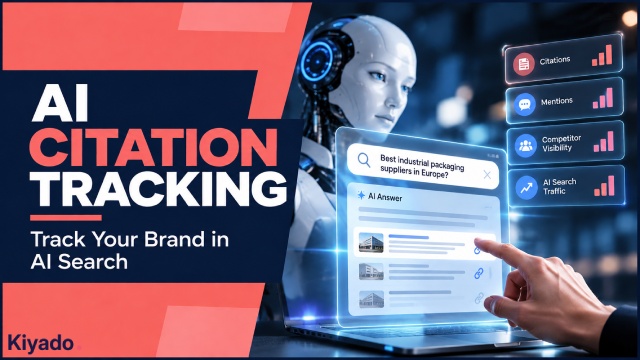
AI-powered search is changing how people discover and evaluate brands. Instead of relying only on traditional search results, users can now ask AI platforms to research topics, compare businesses, and recommend products or services. This creates a new measurement challenge for marketers. A brand may appear in an AI-generated answer without receiving a traditional search click, making rankings and website traffic alone insufficient for understanding visibility. AI citation tracking helps solve this by showing when your brand or content is referenced in AI-generated answers, which sources are being used, and how your visibility compares with competitors. That makes citation tracking an important part of measuring and improving AI search visibility.
What Is AI Citation Tracking?
AI citation tracking is the process of monitoring when and where a brand’s website or other digital content is referenced in AI-generated answers. A citation is different from a brand mention. A mention means AI refers to your brand in an answer, while a citation means AI uses your content or website as a supporting source. Citation quality also matters because a useful citation should be relevant, credible, and connected to the question being answered. The goal is not simply to collect more citations. It is to understand which questions generate citations, which sources are being used, and where competitors have an advantage.
Why Do AI Citations Matter?
AI systems can synthesize information from multiple sources when answering complex questions. A brand that consistently provides useful and credible information has more opportunities to become part of that research process. Tracking citations can help you understand AI search visibility, identify topics where your content is referenced, find competitor gaps, check brand accuracy, prioritize content improvements, and connect AI visibility with business outcomes. For a broader understanding of GEO and how brands can improve their visibility across AI-powered search, see the Generative Engine Optimization (GEO) guide.
How to Track AI Citations
- Build a Target Prompt List — Start with questions your customers are likely to ask AI. Include informational, comparison, industry, problem-solving, and brand-related questions. Keep the prompt list consistent so you can compare results over time.
- Record the AI Results — For each prompt, record whether your brand was mentioned, whether your website was cited, which page was cited, which competitors appeared, what information AI presented, and whether it was accurate.
- Calculate Citation Rate — Citation Rate = Prompts Where Your Content Was Cited ÷ Total Relevant Prompts × 100. For example, if your content is cited for 20 out of 100 tracked prompts, your citation rate is 20%. The number becomes more useful when you measure it consistently over time.
How to Find AI Citations for a Website
Finding AI citations for a website helps you understand whether your content is being referenced in AI-generated answers. By tracking cited URLs, brand mentions, and the sources used by AI-powered search experiences, you can identify opportunities to improve your website's visibility.
Step 1: Identify Relevant Search Prompts
Start by creating a list of questions your target audience might ask AI tools about your industry, products, services, and common problems. Include informational, comparison, and service-related questions.
Step 2: Test AI Search Platforms
Enter your selected prompts into relevant AI search experiences. Use the same prompts consistently so you can compare results over time.
Step 3: Check the Cited Sources
Review the answers for links, references, and source URLs pointing to your website. Record whether your brand is mentioned, your content is directly cited, or a competitor appears instead.
Step 4: Record and Organize Your Findings
Create a spreadsheet with columns for the prompt, AI platform, date checked, cited URL, brand mention, and competing sources. This helps you identify which pages are appearing in AI-generated answers.
Step 5: Monitor Changes Over Time
Repeat your checks regularly using the same prompt set. Compare the results to identify newly cited pages, lost citations, and content opportunities.
Important: AI-generated answers can vary between runs, and not every platform exposes its sources. Treat your findings as observations from the platforms and prompts you tested, rather than a complete record of all AI citations.
What Should You Measure?
- A practical AI citation tracking dashboard can include:
- Citation Rate — How often your content is cited
- Brand Mention Rate — How often your brand appears
- Citation Quality — Relevance and authority of cited sources
- Competitor Visibility — Which competing brands appear
- Brand Accuracy — Whether AI describes your business correctly
- AI-Referred Traffic — Visits influenced by AI discovery
- Conversions — Business outcomes associated with visibility
- How to Measure GEO: Key Metrics and KPIs for AI Search Visibility in 2026.
How to Measure AI Citation Decay
AI citation decay refers to a decrease in how frequently a website or content page appears as a cited source in AI-generated answers over time. Monitoring this change helps businesses identify pages that may be losing visibility and investigate why their content is being referenced less often.
Step 1: Establish a Baseline
Choose a consistent set of relevant prompts and record how often your website is cited across the AI platforms you monitor. Save the dates, cited URLs, and results.
Step 2: Repeat the Same Tests
Run the same prompts periodically using the same platforms and a consistent checking method. This makes it easier to compare citation patterns between measurement periods.
Step 3: Calculate the Citation Rate
Divide the number of prompts that produce a citation to your website by the total number of prompts tested, then multiply by 100.
Citation Rate = (Prompts with Website Citations ÷ Total Prompts Tested) × 100
For example, if your website is cited for 12 out of 40 prompts, your citation rate is 30%. If it is cited for only 6 out of the same 40 prompts in the next measurement period, the rate falls to 15%.
Step 4: Investigate Lost Citations
Review the pages that no longer appear as sources. Check whether their information is outdated, important questions are unanswered, competing sources provide more useful information, or the AI platform's responses have changed.
Step 5: Improve and Monitor Your Content
Update outdated information, add useful evidence and examples, improve content structure, and strengthen relevant internal links where appropriate. Repeat your measurements to see whether citation visibility changes.
Remember: A decline in your tracked citation rate does not necessarily mean your overall AI visibility has declined everywhere. Results can vary by platform, prompt, and measurement period, so use a consistent process and interpret the findings carefully.
How to Find Citation Gaps
A citation gap exists when AI regularly uses other sources or competitors for questions relevant to your business, while your content is absent. For example: Customer question → Competitor cited → Your brand absent. Look for competitors being cited for topics you already cover, your content being mentioned but not cited, important customer questions with no relevant content, outdated business information, and weak supporting evidence. The objective is not to copy competitor content. Instead, identify what useful information is missing from your own content and improve it.
How to Improve Your AI Citations
Create Direct, Useful Answers — Answer important questions clearly and provide the information users need without unnecessary content. Add Original Evidence — Research, first-hand experience, expert insights, case studies, examples, and proprietary information can make content more valuable and distinctive. Improve Content Structure — Use descriptive headings, concise explanations, tables, examples, and logical sections so important information is easy to understand.These factors are closely connected to how LLMs choose which sources to cite. Strengthen Brand Information — Make sure your company name, services, expertise, locations, and other important business information are clear and consistent across your digital presence. Maintain Technical SEO — Crawlability, indexability, internal linking, and site architecture remain important foundations for making information accessible to search systems.
Common AI Citation Tracking Mistakes
- Tracking Only Citations — Citations are useful, but brand mentions, accuracy, competitor visibility, traffic, and conversions provide additional context.
- Changing Prompts Constantly — Using different questions every time makes it difficult to determine whether visibility has actually changed.
- Chasing Citation Volume — More citations do not automatically mean better visibility. Relevance, accuracy, and source quality matter.
- Ignoring Competitors — Competitor visibility can reveal topics where other brands are providing information that AI systems find useful.
- Measuring Only Once — AI search results can change over time. Use a fixed prompt list and test it consistently to establish a baseline and identify meaningful changes.
Final Takeaway
AI citation tracking helps businesses understand whether their content is becoming a useful source within AI-generated answers. Start with a consistent set of customer questions. Track mentions, citations, competitors, accuracy, citation quality, traffic, and conversions. Then use those insights to improve content, evidence, brand information, and technical accessibility. The goal is not to chase citations for their own sake. It is to build useful, credible information that AI systems can understand, verify, and use when answering relevant customer questions. Explore our GEO services to improve your AI search visibility and citation performance, or contact our team to discuss your GEO strategy.