
The term "generative engine optimization" is less than three years old.
The shift behind it began more than a decade ago, when Google started answering questions instead of just listing websites.
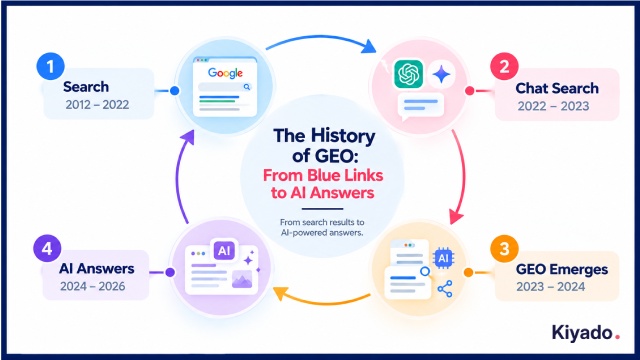
GEO grew in four stages:
-
Search engines started answering (2012–2022).
-
Chat became a way to search (2022–2023).
-
Researchers named and measured the practice (2023–2024).
-
AI answers became the default (2024–2026).
Each stage rewarded brands that made their facts easy for machines to use. Each stage punished brands that didn't.
Stage 1: Search Starts Answering (2012–2022)
2012: the Knowledge Graph. Google began treating the web as a map of things (companies, people, products) rather than a pile of pages. The idea of an "entity" entered SEO.
2014: featured snippets. Google started lifting a paragraph from a page and showing it above the results. For the first time, a search could end without a click.
Late 2010s: voice assistants. Siri, Alexa and Google Assistant read out one answer, not ten. Answer engine optimization (AEO) grew from this: the practice of formatting content so a machine can lift one clean answer.
What it rewarded:
-
clear definitions
-
structured data
-
pages that answered a question in the first sentence
Most B2B sites ignored it. Their brochure-style pages rarely won a snippet.
Stage 2: Chat Becomes a Search Tool (November 2022–2023)
This is where the real break happened.
-
November 2022: ChatGPT launches.
-
December 2022: Perplexity launches, built around cited answers.
-
February 2023: Microsoft adds chat answers to Bing.
-
May 2023: Google announces its Search Generative Experience.
Within six months, buyers could ask a full question and get a written answer that pulled from many sources.
Marketers noticed the change before they had a name for it. The common questions were "How do we show up in ChatGPT?" and "Does SEO still work?" Nobody could answer them with evidence.
Stage 3: The Practice Gets a Name (November 2023–August 2024)
In November 2023, researchers from Princeton, Georgia Tech, the Allen Institute for AI and IIT Delhi published a preprint titled "GEO: Generative Engine Optimization."
The paper was presented at the ACM SIGKDD conference in Barcelona in August 2024. It did two things that mattered:
-
It named the practice, giving marketers and researchers a shared term.
-
It made the practice measurable. It introduced a benchmark and visibility measures, so tactics could be tested instead of guessed.
Its central finding set the tone for everything that followed: verifiable evidence improved visibility in AI answers, and keyword tricks didn't.
Stage 4: AI Answers Become the Default (2024–2026)
Once there was a name, the platforms supplied the urgency.
| Date | Milestone | Why it mattered |
|---|---|---|
| May 2024 | Google launches AI Overviews in the U.S. | AI answers appear above organic results for mainstream searches |
| September 2024 | The llms.txt standard is proposed | Sites get a suggested way to guide AI systems to their key content |
| October 2024 | ChatGPT launches built-in web search | Its answers draw on live web pages, with citations |
| May 2025 | Google launches AI Mode in the U.S. | Query fan-out goes mainstream: one question becomes many searches |
| 2025–2026 | Large studies measure AI citations and click loss | GEO moves from theory to measurement |
The last row matters most. By 2026, marketers could finally track what was happening:
-
which signals correlate with being cited
-
how much traffic AI answers absorb
-
how buyers use AI to shortlist vendors
Interest in the term followed. Ahrefs reports that monthly searches for "generative engine optimization" went from almost none to about 12,000, up 161% in a year.
What Comes Next
These are trends to watch, not proven outcomes.
1. AI agents that act.
Buyers will ask AI agents to shortlist suppliers, compare quotes and request samples. An agent can only contact a vendor whose details it can find and trust.
2. Private company AI tools.
Forrester found 61% of business buyers already use AI tools supplied by their employer. More vendor research will happen inside tools you can't see or track.
3. Visual search.
Buyers photograph a part on a booth counter and ask the AI who else makes it. Product images with clear, structured descriptions will matter more.
What History Teaches Exhibitors
Look back across all four stages and the same lesson repeats.
The brands that won each shift were the ones whose facts were easiest for machines to read, check and repeat.
-
The snippet era rewarded clear definitions.
-
The chat era rewarded content backed by evidence.
-
The AI Overview era rewards being cited and mentioned across the web.
The platforms kept changing. The rule didn't.
For exhibitors, the pattern is familiar. Early adopters of snippet optimization won visibility their competitors took years to catch up to. The same window is open now, and it won't stay open.
Back to the master guide: GEO Fundamentals, The Complete Guide
Want to get ahead of the next shift? Kiyado's generative engine optimization service builds the foundations that have carried across every stage of search, including clear facts, consistent brand details and third-party proof, so your brand stays visible whichever platform comes next.