
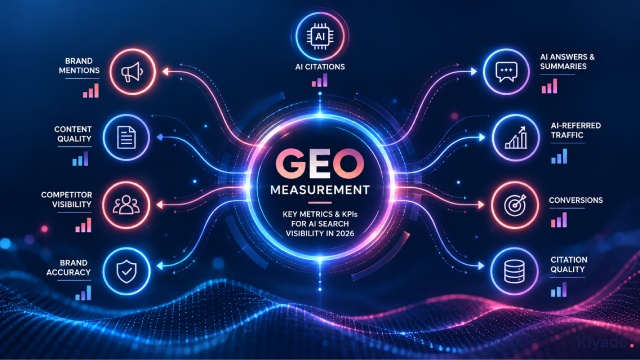
Improving visibility in AI-powered search is only half the job. Businesses also need to understand whether their efforts are actually working. Traditional SEO often focuses on rankings, impressions, clicks, and organic traffic. GEO measurement requires a broader view because an AI system may mention, cite, or recommend a brand without generating a direct website visit. The most useful approach is to track AI visibility, citations, brand accuracy, competitor presence, traffic, and business outcomes together. To measure GEO effectively, businesses can establish a baseline, monitor these metrics consistently, and use GEO audit tools to identify areas for improvement. Geoptie helps assess citation readiness, answer alignment, content authority, technical optimization, and competitive positioning, while SEOmator provides insights into AI citability, E-E-A-T, schema, AI crawler access, platform readiness, and technical SEO.
What Is GEO Measurement?
GEO measurement is the process of tracking how often and how accurately a brand appears across AI-generated answers and other generative search experiences. Instead of asking only, “Did our page rank?” you also ask: “Does AI mention our brand when customers ask relevant questions?” This makes GEO measurement complementary to traditional SEO rather than a replacement for it. Generative Engine Optimization (GEO) guide
7 Key GEO Metrics to Track
1. Brand Mention Rate
Brand mention rate measures how frequently your brand appears in relevant AI-generated answers. Track total target prompts, prompts where your brand appears, competitors mentioned, and changes over time. A rising mention rate can indicate that your brand is becoming more visible within relevant AI research journeys.
2. AI Citation Rate
A brand mention and a citation are not the same thing. A citation rate measures how often your website or other content is used as a source in AI-generated answers. This helps answer an important question: Is AI simply mentioning the brand, or is it using the brand’s content as supporting information? AI Citation Tracking For practical GEO measurement, audit tools can also help identify whether your content is structured and ready to be cited. Geoptie Free GEO Audit evaluates areas such as citation readiness, answer alignment, knowledge graph optimization, content authority, technical optimization, and competitive positioning.
3. Competitor Visibility
Your visibility should not be measured in isolation. Track which competitors appear for the same prompts and compare brand mentions, citations, prominence within answers, frequency of appearance, and topics where competitors are consistently visible. This can reveal content gaps that traditional ranking reports may not show.
4. Brand Accuracy
AI visibility is not automatically valuable if the information is incorrect. Brand accuracy measures whether AI systems describe your business correctly. Check your products or services, areas of expertise, locations served, industry focus, and company information. Entity SEO for GEO
5. Citation Quality
Not every citation has the same value. Consider where your brand is cited and what information the citation supports. Look at citation relevance, source authority, context, accuracy, and the importance of the prompt. These factors are closely connected to how LLMs choose which sources to cite.
6. AI-Referred Traffic
Some AI interactions eventually lead users to a website. Monitor traffic that can be attributed to AI discovery where reliable referral data is available. Compare it with organic search, direct traffic, referral traffic, branded search activity, and landing-page engagement. Traffic should not be the only GEO KPI.
7. Conversions
The ultimate question is whether increased AI visibility contributes to business results. Depending on the business, conversions could include form submissions, calls, demo requests, purchases, sign-ups, or enquiries.
How to Measure GEO Step by Step
Step 1: Create a Prompt Set
Build a fixed list of questions that potential customers might ask AI. Include informational, comparison, commercial, brand-related, and industry-specific intent.
Step 2: Record the Baseline
Run the prompts and record whether your brand appears, whether your website is cited, which competitors appear, and how your brand is described. You can also use GEO audit tools alongside your prompt testing to identify technical, content, schema, and AI-readiness gaps. SEOmator GEO Audit Tool can analyze up to 50 pages and provides page-level analysis, block-level citability scoring, E-E-A-T analysis, schema checks, AI crawler access reports, platform readiness, and prioritized recommendations.
Step 3: Repeat the Test
Use the same prompt set regularly instead of changing the questions every time. This makes it easier to identify changes in visibility.
Step 4: Connect Visibility to Business Data
Compare AI visibility with website visits, branded searches, enquiries, and conversions where measurable.
Step 5: Find the Gaps
If competitors consistently appear but your brand does not, investigate what information they provide that your content lacks.
What Should You Track Monthly?
| KPI | What It Tells You |
|---|---|
| Brand Mention Rate | How often your brand appears |
| Citation Rate | How often your content is cited |
| Competitor Visibility | Who appears instead |
| Brand Accuracy | Whether information is correct |
| Citation Quality | Strength and relevance of sources |
| AI-Referred Traffic | Visits influenced by AI |
| Conversions | Business impact |
Measuring only website traffic
AI can influence users before they visit your website, so traffic alone provides an incomplete picture.
Changing prompts every time
Changing your questions makes historical comparisons difficult. A consistent prompt set gives you a more useful baseline.
Tracking mentions without accuracy
A brand appearing in an AI answer is not necessarily positive if the description is outdated or incorrect.
Ignoring competitors
Your visibility becomes more meaningful when you understand who appears for the same customer questions.
Measuring once and stopping
AI search experiences continue to change. GEO measurement should therefore be an ongoing process rather than a one-time audit.
Final Takeaway
GEO success cannot be reduced to a single number. A useful measurement framework combines brand mentions, citations, competitor visibility, brand accuracy, citation quality, AI-referred traffic, and conversions. Start with a fixed set of important customer prompts, establish a baseline, measure consistently, and connect visibility changes to real business outcomes. If you want to improve your AI visibility and measure your performance systematically, explore our GEO services or contact our team to discuss how we can help improve and measure your AI search visibility.

Rizwan Mohammed
Rizwan leads search and AI-visibility strategy at Kiyado, with 15+ years in SEO and a hands-on focus on turning analytics into a working roadmap rather than a monthly report nobody reads.