Your search impressions are up. Your rankings haven't moved. But your clicks keep falling.
You're not doing anything wrong. You're watching zero-click search happen in your own analytics.
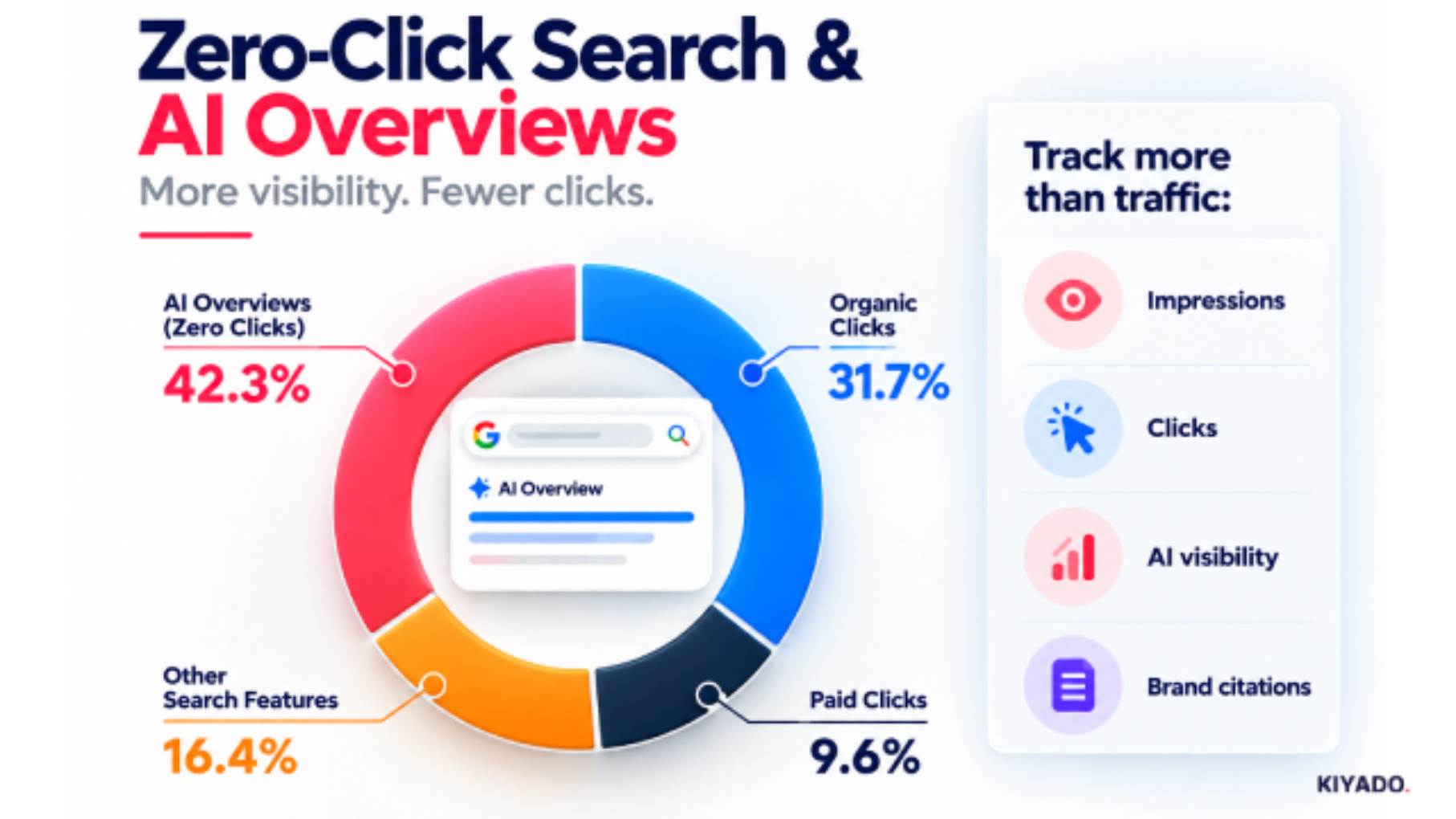
Zero-click search is a search that ends without the user visiting any website, because the answer appears on the results page itself. Google's AI Overviews have made it far more common. Here's how much it costs, why being cited changes the numbers, and what to measure now.
What "Zero-Click" Actually Means
Zero-click isn't new. Featured snippets, knowledge panels and instant answers have ended searches on Google for years.
AI Overviews changed the scale. Instead of answering simple facts, Google now writes summaries for:
-
comparisons
-
how-to questions
-
"best supplier for…" questions
These are the searches B2B buyers make when they're researching.
How Big Is the Drop?
Ahrefs compared clicks on 300,000 keywords in December 2023, before AI Overviews launched, with December 2025. When an AI Overview appeared, the top-ranking page got 58% fewer clicks.
That's up from a 34.5% drop Ahrefs measured in April 2025. In Ahrefs' own framing: for every 100 clicks a top-ranking page used to earn, Google now keeps 58.
Seer Interactive, tracking 2.43 billion impressions across 53 brands, found a similar pattern with a twist:
-
Click-through rate on AI Overview searches hit a low of 1.3% in December 2025.
-
By February 2026 it had recovered to 2.4%.
The lesson: these numbers move quickly. Don't build a plan on any single figure. Build it on the direction of travel, and that direction is clear: fewer clicks when AI answers first.
Being Cited Changes the Math
This is the part most traffic reports miss.
Seer compared brands that were cited inside an AI Overview with brands that weren't. Cited brands got 35% more organic clicks and 91% more paid clicks than uncited brands.
Seer's 2026 update found the same gap:
-
Cited pages earned about 120% more clicks per impression than uncited pages.
-
But cited pages still earned 38% fewer clicks than pages on searches with no AI Overview at all.
So:
-
Not cited: you lose the most.
-
Cited: you lose less, and you're part of the answer the buyer reads.
-
No AI Overview: the old click rates still apply, but fewer searches work this way.
Seer is careful about one thing: it can't prove that being cited causes the extra clicks. Brands with more authority may simply be cited more often.
Either way, being cited is where you want to be.
The Clicks You Keep Are Worth More
Fewer clicks doesn't have to mean fewer customers.
Ahrefs' own website:
-
AI search sent only 0.5% of its traffic.
-
Those visitors produced 12.1% of its signups.
-
That's a conversion rate 23 times higher than traditional organic search.
Treat that as one company's result, not a benchmark. It's the highest figure published, and it comes from a software business.
Seer's data points the same way. On searches without an AI Overview, click-through rates rose from 2.8% in early 2025 to 3.8% by February 2026. When the AI handles quick answers, the people who still click tend to be looking for more.
The pattern: the AI answer screens out casual researchers. The buyers who reach your site have already been told why you're relevant.
What This Means for B2B Exhibitors
Not all your pages are equally exposed.
Hit hardest: informational pages.
-
guides
-
definitions
-
"how to choose" articles
-
comparisons
These are the searches AI Overviews answer most often.
Least affected: commercial pages.
-
RFQ forms
-
product configurators
-
contact pages
Buyers still need to visit these to take action.
So the strategy splits in two:
-
Informational content: aim to be cited, not clicked. Success means your brand and your facts appear inside the answer.
-
Commercial pages: aim to convert. The visitors who arrive are fewer but further alon
Change What You Measure
Seer suggests replacing traffic and click targets with three measures:
-
your share of voice in AI citations
-
growth in branded searches
-
conversions that AI played a part in
For exhibitors, put it into practice with four steps:
-
Find your zero-click searches. In Google Search Console, look for queries where impressions are rising and clicks are falling.
-
Track AI referrals separately. Create a channel group in GA4 for ChatGPT, Perplexity, Gemini and Copilot traffic.
-
Watch branded searches after each show. A rise in people searching your name suggests AI answers and booth visits are working together.
-
Ask on your enquiry form. Add "AI assistant" to the "How did you hear about us?" options.
These losses rarely show up as a clear drop, because buyers increasingly make their decisions out of your sight.
Related: The Answer Economy explained
Back to the master guide: GEO Fundamentals, The Complete Guide
Losing clicks and don't know whether you're being cited instead? Kiyado's generative engine optimization service maps which of your searches trigger AI answers, whether you're cited in them, and what to fix so you're counted inside the answer.