
Your agency says "query fan-out." Your CMO asks about "share of voice in AI." A vendor pitches "llms.txt."
This glossary defines the 30 terms you'll hear most in generative engine optimization. Each definition is one or two sentences in plain English. Bookmark it.
The Disciplines
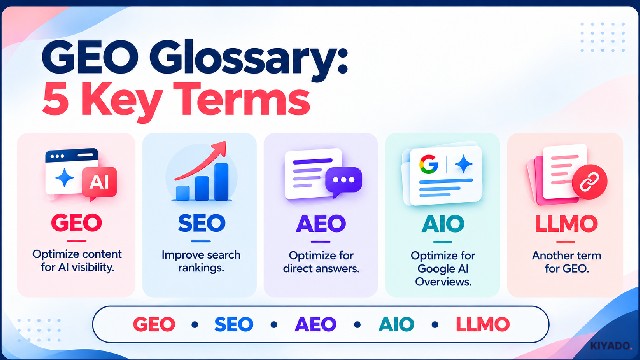
Generative Engine Optimization (GEO)
The practice of making your content, brand identity and presence across the web easy for AI systems to find, trust and cite, so your brand appears in AI-written answers.
Search Engine Optimization (SEO)
The practice of earning high positions in a search engine's ranked list of links. It's the technical foundation GEO depends on.
Answer Engine Optimization (AEO)
Formatting content so a system can lift one direct answer, as in featured snippets, voice assistants and "People Also Ask" boxes.
AI Overviews Optimization (AIO)
Optimizing to appear inside Google's AI Overviews specifically. Some vendors use "AIO" to mean AI optimization in general, so ask which one they mean.
LLM Optimization (LLMO)
An alternative name for GEO. It focuses on large language models rather than search engines
How AI Answers Get Made
Large Language Model (LLM)
The AI model that reads and writes text. GPT, Gemini and Claude are examples.
Generative Engine
Any AI system that writes an answer instead of returning a list of links. Examples include ChatGPT, Perplexity, Gemini, Copilot and Google's AI features.
Training Data
The text a model learned from before release. It's fixed at a knowledge cutoff date and can't be updated afterwards.
Live Retrieval
When an AI engine fetches web pages at the moment a question is asked, instead of relying only on what it learned in training.
Retrieval-Augmented Generation (RAG)
The process of fetching relevant sources first, then writing an answer based on them. Most AI search works this way.
Query Fan-Out
When an AI engine splits one question into several smaller searches. Google describes AI Mode as issuing many searches on the user's behalf at the same time.
Passage
A self-contained section of a page. AI engines extract passages, not whole pages, so each section has to make sense on its own.
Grounding
Tying an AI answer to specific retrieved sources, so the claims can be traced back and checked.
Hallucination
When an AI states something false with confidence. It happens more often when accurate, consistent facts about a subject are hard to find.
Trust and Authority Signals
Entity
A clearly defined "thing" an AI system can recognise, such as your company, a product line or a named expert. Clear entities are easier to recommend.
Knowledge Graph
Google's database of entities and how they relate to each other. It has shaped search results since 2012.
Brand Mention
Any reference to your brand on another website, with or without a link. In Ahrefs' study of 75,000 brands, web mentions correlated more strongly with AI Overview visibility than backlinks did.
Corroboration
When several independent sources confirm the same fact about you. AI engines trust facts that are backed up elsewhere.
E-E-A-T
Experience, Expertise, Authoritativeness and Trustworthiness. These are Google's quality criteria, and they're a useful checklist for any content you want cited.
Content Freshness
How recently a page was meaningfully updated. In one Ahrefs study, the content AI assistants cited was on average 25.7% fresher than content in Google's organic results.
Structured Data (Schema)
Code added to a page that labels facts explicitly, such as a product name, an organisation or an FAQ, so machines can read them without guessing.
llms.txt
A proposed file that points AI systems to a site's most important content. It's a proposal, not a standard. Don't expect it to fix anything on its own.
AI Crawlers
Bots that AI companies use to read websites. OpenAI, for example, runs OAI-SearchBot for its search index and GPTBot for collecting training data. They're controlled separately in robots.txt.
Visibility and Measurement
Mention, Citation, Recommendation
Three levels of AI visibility:
● Mention: the AI names your brand.
● Citation: it links to your page as a source.
● Recommendation: it puts you on the buyer's shortlist.
AI Share of Voice
How often your brand appears in AI answers for a set of prompts, compared with your competitors.
Prompt Testing
Running the questions your buyers ask through ChatGPT, Gemini, Perplexity and other platforms, then recording who gets named, cited and recommended.
Zero-Click Search
A search that ends without a visit to any website, because the answer appeared on the results page.
AI Referral Traffic
Visitors who arrive by clicking a link in an AI answer. The volume is small, but these visitors often arrive with strong buying intent.
Related: Zero-click search and AI Overviews
The Bigger Picture
AI Overviews and AI Mode
Google's two AI answer formats.
● AI Overviews are summaries shown above normal search results.
● AI Mode is a separate conversational search experience.
Answer Economy
G2's name for the shift in B2B buying, where buyers ask AI to synthesise their research and produce a shortlist instead of browsing sources themselves.
Missing a term? GEO vocabulary changes as fast as the platforms do. We update this glossary as new terms become established.
Back to the master guide: GEO Fundamentals, The Complete Guide
Not sure which layer is holding you back? Kiyado's generative engine optimization service starts with an audit across the whole stack, from crawlability to AI citations, so you fix the right layer first.
Talk to Kiyado about GEO