
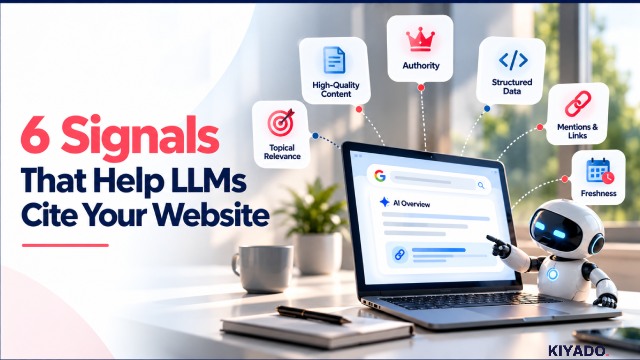
You rank first on Google for your main product term.
Then you ask ChatGPT the same question. It cites a trade directory, a YouTube video and a competitor's page from last month. Your page isn't mentioned.
LLMs don't cite the page that ranks highest. They cite the sources that best answer each part of the question, that other sites back up, and that look current. No AI company publishes its rules, but large studies now show which signals matter most.
Here are six you can influence.
Signal 1: Rankings Help Less Than You'd Expect
Rankings still matter. They just don't decide the outcome.
-
July 2025: an Ahrefs study found 76% of pages cited in Google's AI Overviews also ranked in the top 10.
-
March 2026: Ahrefs re-ran the study across 863,000 keywords. The figure had fallen to 38%.
Ahrefs says its method for detecting citations improved between the two studies, so the numbers aren't directly comparable. Other firms report figures from about 17% to 54%, depending on how they count.
For AI assistants the gap is wider. On average, only about 11% of citations from AI assistants matched the top 10 results on Google or Bing for the original prompt.
Why: engines search the sub-questions behind the original prompt, not just the prompt itself. A page can be cited for a sub-question it answers well, even if it doesn't rank for the main term.
Signal 2: Brand Mentions Outweigh Backlinks
This is the most important finding for B2B brands.
Ahrefs analysed 75,000 brands. Mentions of a brand across the web showed the strongest link to AI Overview visibility, with a correlation of 0.664. Backlinks scored just 0.218.
The gap between brands is large. Brands in the top 25% for web mentions averaged 169 AI Overview mentions. The next group down averaged 14.
A follow-up covering ChatGPT and Google AI Mode found an even stronger signal: mentions on YouTube correlated more strongly with AI visibility than any other metric Ahrefs measured.
Two caveats:
-
This is correlation, not proof of cause.
-
The sample leaned toward established companies. It only included domains with a Domain Rating above 40.
For exhibitors: every show creates chances to be mentioned:
-
trade press coverage
-
partner announcements
-
association news
-
booth demo videos on YouTube
Most exhibitors capture none of them.
Signal 3: Freshness
Ahrefs looked at about 17 million citations. The content AI assistants cited was, on average, 25.7% fresher than the content ranking in Google's organic results.
The details vary by platform:
-
ChatGPT showed the strongest preference for recent pages.
-
Google's AI Overviews were the exception. They cited content slightly older than the organic results.
Freshness has to be real. Changing a publish date without changing the content doesn't help, and both Google and AI retrieval systems increasingly ignore it.
For exhibitors: update your key pages after every show with something genuinely new:
-
current lead times
-
new certifications
-
the questions buyers asked at the booth
Signal 4: Evidence You Can Check
The research that named GEO found the biggest visibility gains came from adding statistics, citations and quotes from credible sources.
The reason is simple. An engine that has to justify its answer prefers sources that come with proof.
Compare these two lines:
-
"Trusted by manufacturers worldwide." Nothing to check.
-
"ISO 9001-certified since 2014; supplying 40+ plants across 11 countries." Something to cite.
Signal 5: Consistency
When sources disagree, engines hedge or skip the claim.
If your website says 12 export markets, your expo listing says 8 and LinkedIn says "global," the engine can't tell which is true. It may repeat the wrong number, or leave your brand out.
Pick one version of every key fact and make it identical everywhere it appears.
Signal 6: Access
None of the signals above count if the engine can't reach your page.
Check two things:
-
Your robots.txt and firewall settings. Make sure they allow the search crawlers AI platforms use, such as OpenAI's OAI-SearchBot.
-
Your key facts live on HTML pages, not only inside PDFs.
A 10-Minute Citation Audit
| Signal | Quick check |
|---|---|
| Rankings | Do you rank for the sub-questions buyers ask, not just the main term? |
| Brand mentions | Search your brand name without your own domain. How many third-party pages come up? |
| Freshness | When were your top five product pages last meaningfully updated? |
| Evidence | Does each key page contain at least one verifiable number? |
| Consistency | Do your website, LinkedIn and expo listings match word for word? |
| Access | Are AI search crawlers allowed in your robots.txt? |
Every "no" in that table is a reason an engine cites someone else.
Winning citations matters most at the shortlist stage, when buyers are deciding who to contact.
Related: The Answer Economy explained
Back to the master guide: GEO Fundamentals, The Complete Guide
Want to know which signal is costing you citations? Kiyado's generative engine optimization service measures where AI engines cite you and your competitors, then fixes the gaps in order of impact.