
A procurement lead used to open twelve browser tabs to research suppliers.
Now she types one question into the AI tool her company provides and gets back a shortlist of four names, with reasons.
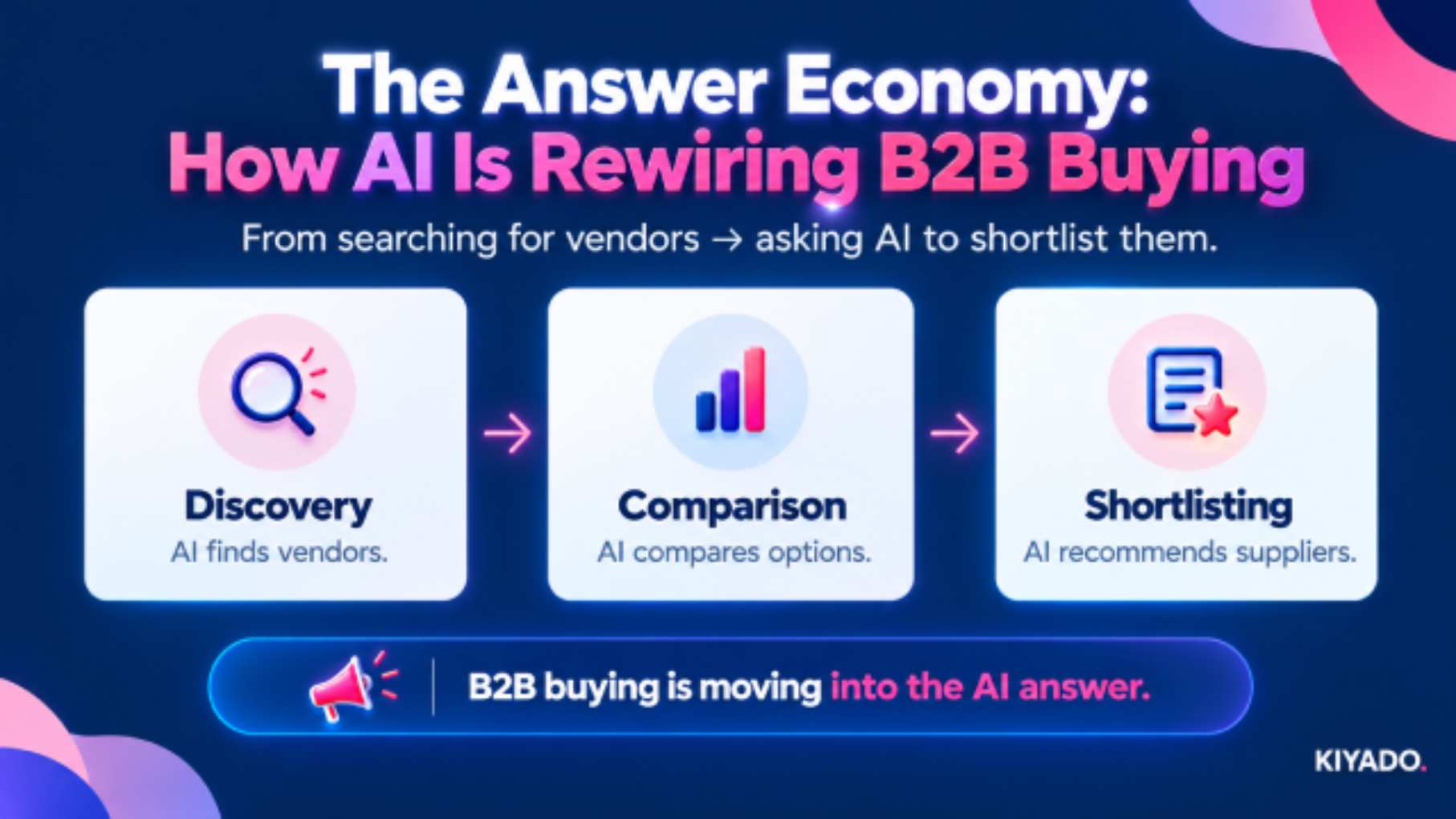
The Answer Economy is the shift from buyers searching for vendors to buyers asking AI to choose between them. Discovery, comparison and shortlisting now happen inside a chat window, before any vendor knows the buyer exists.
Here's what that means, and where your brand fits.
The Answer Economy, Defined
G2 coined the term in its April 2026 report on B2B buying. It describes buyers who used to ask search engines for references and now ask AI to pull everything together and hand back a shortlist.
That's the core change:
-
Search engines gave buyers sources. The buyer read them and decided.
-
AI gives buyers conclusions. The buyer checks them and decides.
Your brand used to compete for the buyer's attention. Now it competes for the AI's recommendation first.
It Isn't Just Software Buyers
G2's survey covered software buyers only. A fair question is whether industrial, manufacturing and service buyers behave the same way.
Forrester's 2026 research suggests they do:
-
94% of business buyers used AI in their buying process, up from 89% a year earlier. The survey covered nearly 18,000 buyers worldwide.
-
Twice as many buyers named generative AI or conversational search as their most meaningful information source than named any other source. That puts it ahead of vendor websites, product experts and sales reps.
-
61% of buyers use private AI tools supplied by their own employer.
That last number matters. Many of these conversations happen inside company AI tools you can't see or track. Your only influence is what those tools can find and trust about you.
What Buyers Hand Over to AI
Buyers don't hand AI the whole purchase. They hand it the slow, early work:
-
Scanning the market: "Who makes this?"
-
Building a shortlist: "Which three should I contact?"
-
Comparing options: "How do these differ on lead time and certifications?"
-
Drafting requirements: "What should I ask suppliers?"
The shortlist is the stage where AI has the most influence. G2 found buyers rank AI chatbots as the top source shaping their shortlists. One in three bought from a vendor they had never heard of before.
If the AI doesn't name you at the shortlist stage, your sales team never gets a chance.
What Buyers Still Do Themselves
AI shortens discovery. It doesn't replace trust.
Forrester found that AI search is where business buyers start. But to justify and de-risk the final decision, they rely more and more on colleagues and outside advisers.
G2 found the same pattern. Buyers trust AI recommendations but still check them against review sites.
So the buying journey now has two halves:
-
Machine research: AI finds, filters and compares vendors.
-
Human validation: colleagues, reviews, reference calls and face-to-face meetings confirm the choice.
Most B2B marketing teams are built for the second half. The first half is where deals now start.
Where Exhibitors Fit
Here's the good news for exhibitors. A trade show is one of the strongest human-validation events in B2B. Buyers see the product, meet the engineers and judge the company in person.
The catch: buyers increasingly decide which booths to visit after asking AI. Validation only helps you if you made the machine's shortlist first.
Our recommended approach covers both halves.
Before the show:
-
Publish clear, answer-first pages for the questions buyers ask when building shortlists: capacity, certifications, export markets and lead times.
-
Make your exhibitor listing match your website exactly.
At the show:
-
Log the questions buyers ask at the booth.
-
Each one is a prompt someone will type into an AI tool later.
After the show:
-
Turn those questions into published answers.
-
Send follow-ups that are easy for AI to read. Buyers often paste vendor documents into their own AI tools to compare suppliers. A fact sheet with clear numbers compares better than a brochure full of adjectives.
What decides whether the AI trusts your facts is a separate question.
Signs You're Losing in the Answer Economy
Because it happens out of sight, the loss rarely shows up as a clear drop. Watch for these instead:
-
Fewer RFQs from buyers you've never met, while referrals hold steady.
-
Deals lost to smaller competitors you didn't consider serious.
-
Buyers repeating wrong facts about you, like old prices, discontinued products or wrong locations. They're quoting an AI summary.
-
Website traffic falling faster than enquiries.
The last sign ties into a wider change in how search results work.
Related: Zero-click search and AI Overviews
One fix you can make this week: add "AI assistant (ChatGPT, Gemini, Copilot, etc.)" as an option in the "How did you hear about us?" field on your enquiry form. It's the simplest way to start measuring the channel.
Back to the master guide: GEO Fundamentals, The Complete Guide
Want to know if AI is putting you on buyers' shortlists? Kiyado's generative engine optimization service tests the prompts your buyers use, shows who the AI recommends instead of you, and closes the gap before your next show.