
A buyer types one question into an AI assistant.
Behind the scenes, the engine may run a dozen searches, read hundreds of passages and throw most of them away. Then it writes three paragraphs and names four suppliers.
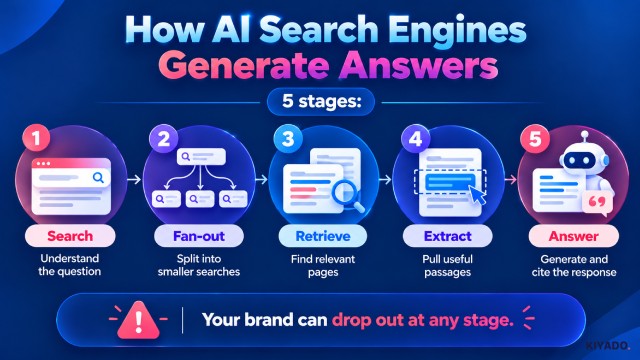
AI search engines generate answers in five stages:
-
They decide whether to search at all.
-
They split the question into smaller searches.
-
They fetch pages.
-
They pull out the useful passages.
-
They write the answer and choose which sources to cite.
Your brand can drop out at any of the five. Here's where, and how to stop it.
Stage 1: Search the Web, or Answer From Memory?
Every engine first decides whether it already knows enough.
If it answers from memory, it relies on training data: what the model absorbed before its cutoff date. Only what was published about you, and repeated across the web, before that date counts. You can't fix that quickly. It builds up over years of mentions.
If it searches the web, you're competing in real time. Buyer questions about suppliers, prices, lead times and comparisons usually trigger a live search, because they depend on current information.
The takeaway: long-term brand mentions shape what the model already believes about you. Your web pages shape what it finds today. You need both.
Stage 2: One Question Becomes Many
This stage is called query fan-out.
Google describes AI Mode as breaking a question into subtopics and running many searches at the same time on the user's behalf. OpenAI says something similar: when ChatGPT search uses a search partner, it usually rewrites the question into one or more targeted queries.
Take a buyer prompt: "Food-grade conveyor supplier with service engineers in the UAE, seen at [Expo Name]."
The engine may search separately for:
-
food-grade conveyor manufacturershire
-
conveyor companies with service coverage in the UAE
-
the [Expo Name] exhibitor list
-
hygiene certifications for conveyors
-
reviews of each candidate
You have to show up in several of those searches, not just one. A supplier that appears in four of them beats a supplier that ranks first for only one.
Stage 3: Retrieval, or Who Gets Fetched
Now the engine collects pages. Where it collects them from depends on the platform.
ChatGPT:
-
It uses third-party search providers, including Microsoft Bing, alongside its own sources.
-
OpenAI says sites must allow its OAI-SearchBot crawler to be eligible for ChatGPT search results.
-
OpenAI's GPTBot is a separate crawler used for model training. You can block GPTBot and still allow OAI-SearchBot. Blocking both by mistake is a common error.
Google:
-
Its AI features draw on the live web, the Knowledge Graph and specialised data such as Shopping.
This is where many exhibitors fail without knowing it. They've never checked their site in Bing Webmaster Tools, and their security settings block AI crawlers by default.
If you aren't fetched, nothing later in the process matters.
Related: GEO vs SEO vs AEO vs AIO
Stage 4: Extraction, Where Passages Win
The engine doesn't read your page the way a person does. It scans for the passages that answer each sub-question and ignores the rest.
That changes how you should write:
-
Put one fact in each sentence. "Lead time: 6–8 weeks to GCC ports" can be extracted. A paragraph that mixes lead times, warranty terms and a sales pitch can't.
-
Label facts with dates. "As of 2026, we service 9 countries" reads as current. An undated claim reads as possibly stale.
-
Give each question its own heading. A clear FAQ section gives the engine ready-made pairs of question and answer.
-
Use tables for specifications. Rows and columns survive extraction better than prose.
Stage 5: Synthesis and Citation
Finally, the engine writes the answer. It combines what it extracted, resolves any conflicts and decides which sources to show.
Three things happen here that most brands don't expect:
-
Being used doesn't guarantee a link. An engine can draw on your page and still show another source as the citation.
-
Contradictions count against you. If your website says one thing and a trade directory says another, the engine may trust neither.
-
Wording spreads. How the engine describes you often echoes the clearest description it found, whether you wrote it or not.
What decides who gets cited is a topic of its own.
| Stage | How brands drop out | Column 3 |
|---|---|---|
| Memory | Few mentions of the brand across the web | Earn coverage in trade press and associations |
| Fan-out | Content covers only the main product term | Write pages for each buyer sub-question |
| Retrieval | Bing ignored, AI crawlers blocked | Check robots.txt, your firewall and Bing Webmaster Tools |
| Extraction | Facts buried in PDFs or brochure copy | Answer-first HTML, tables and dated facts |
| Citation | Brand details conflict across sites | Make every listing match your website |
Back to the master guide: GEO Fundamentals, The Complete Guide
Want to know which stage is costing you? Kiyado's generative engine optimization service traces your brand through all five stages, from crawler access to citations, and fixes the leaks in the right order.