
Last month, an exhibitor showed me three agency proposals.
One sold SEO. One sold AEO. One sold "GEO and AIO." Each had its own retainer, and all three claimed to be the thing that mattered now.
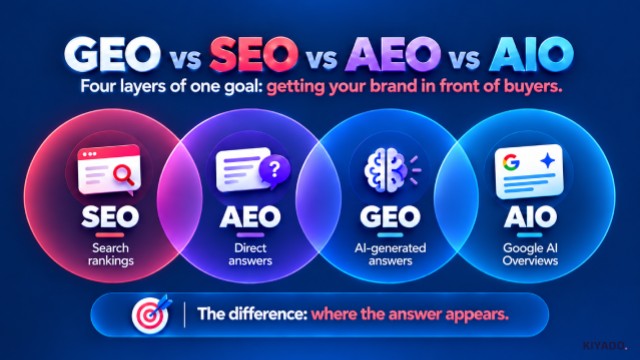
Here's the short answer they needed: these aren't four competing services. They're four layers of one job, which is getting your brand in front of buyers wherever the answer appears.
The difference is where the answer appears.
The Four Terms in One Line Each
-
SEO: rank your pages in the list of search results.
-
AEO: format content so a system can lift one direct answer, as in featured snippets, voice answers and "People Also Ask."
-
AIO: appear inside Google's AI Overviews specifically. (Some vendors use "AIO" to mean AI optimization in general. Ask which one they mean.)
-
GEO: get mentioned, cited and recommended by every AI system that writes answers, including ChatGPT, Gemini, Perplexity, Copilot and Google's AI features.
New to GEO? Related: What is generative engine optimization?
Where Each One Shows Up
Take one buyer search: "stainless steel conveyor manufacturers that export to Europe."
On a classic Google results page (SEO):
-
The buyer sees ten links.
-
Your page ranks fifth.
-
She might click it.
In a featured snippet (AEO):
-
One boxed answer sits above the links.
-
It quotes a paragraph from a single page.
-
If that page is yours, you own the top of the screen.
In an AI Overview (AIO):
-
Google writes a short summary drawn from several sources.
-
It shows citation links alongside.
-
You might be one of those sources, or you might not be mentioned at all.
In ChatGPT or Perplexity (GEO):
-
The buyer gets a written shortlist of named suppliers, with reasons.
-
She may ask follow-up questions and never open Google at all.
Same buyer, same need, four different places to win or lose.
Answer Engine Optimization vs SEO
People searching answer engine optimization vs traditional SEO usually want to know one thing: is AEO a different discipline, or SEO with better formatting?
It's closer to the second, with three real differences:
-
The target. SEO targets a position in a list. AEO targets a single answer slot.
-
The format. SEO rewards thorough pages. AEO rewards a clean 40–60-word answer placed directly under a question-style heading, which systems can lift as it is. [Commonly cited practitioner guideline, not a published rule]
-
The measurement. SEO tracks rankings and clicks. AEO tracks whether you own the snippet or the voice answer, whether or not anyone clicks.
AEO doesn't work without SEO. The page has to rank before its answer can be lifted.
Where GEO Goes Further Than AEO
AEO wins one answer box on one platform. GEO goes further in three ways.
1. Many sources, one answer.
AI engines combine several sources into one response. You're competing to be one of the voices in that response, not the only one.
2. Recommendations, not just definitions.
AEO usually answers "what is" questions. GEO covers "who should I use" questions, which is where buying decisions happen.
3. What happens off your site.
AEO is mostly about the pages you control. GEO depends heavily on what the rest of the web says about you:
-
trade directories
-
review platforms
-
press coverage
-
expo exhibitor listings
G2's 2026 research found that buyers trust AI recommendations but still check them against review sites.
How the Four Fit Together
Think of them as a stack, from the bottom up:
-
SEO is the foundation. Pages are crawlable, indexed and trusted. Nothing above this works without it.
-
AEO is the formatting. Content is shaped into answers that can be lifted cleanly.
-
AIO is Google's AI layer. Your content appears inside Google's AI summaries.
-
GEO is the full picture. Your brand is recognisable, backed up by other sources and recommended across every AI platform.
Each layer depends on the ones below it. A brand with strong GEO signals but a site Google can't crawl will stall. A brand with perfect SEO but no outside mentions will rank and still go unrecommended.
This matters more as AI summaries reduce clicks.
Related: Zero-click search and AI Overviews
Which One Should You Prioritise?
Start with the problem you actually have.
-
Your key pages aren't indexed, or rank beyond page two: fix SEO first. Nothing else will stick.
-
You rank well but never appear in snippets or AI Overviews: work on AEO and AIO. Your content ranks but isn't formatted to be lifted.
-
Competitors are named in ChatGPT and you aren't: this is a GEO gap, and usually an off-site and brand-identity problem, not a page problem.
-
All three apply: you need one plan that covers the whole stack in order.
One warning for exhibitors: don't buy four separate retainers. The layers share the same pages, the same technical base and the same content. Split across vendors, they end up working against each other.
Back to the master guide: GEO Fundamentals, The Complete Guide
Not sure which layer is holding you back? Kiyado's generative engine optimization service starts with an audit across the whole stack, from crawlability to AI citations, so you fix the right layer first.