
Open ChatGPT and type: "Who manufactures [your product] for export to the Middle East?"
Read the answer carefully. That answer is now a sales channel. You don't control it, you can't buy space in it, and most of your competitors aren't watching it.
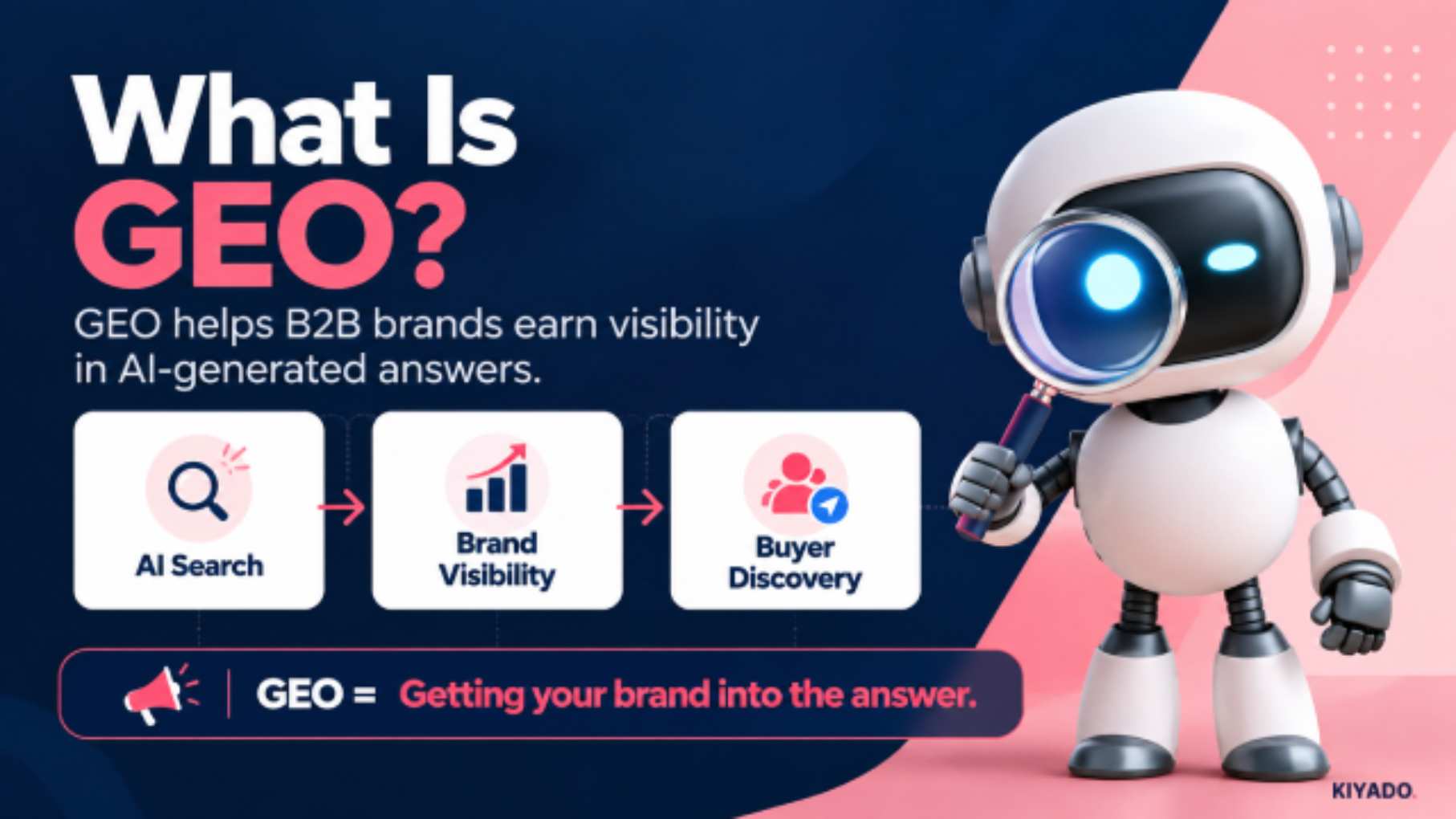
So what is generative engine optimization? It's how you earn a place in that answer.
Generative Engine Optimization, Defined
Generative engine optimization (GEO) is the practice of shaping your content, your brand identity and your presence across the web so that AI systems find you, trust you and name you in the answers they write.
The term has two parts.
"Generative engine" means any AI system that writes an answer instead of returning a list of links. That includes:
-
ChatGPT
-
Gemini
-
Perplexity
-
Claude
-
Microsoft Copilot
-
Google's AI Overviews and AI Mode
"Optimization" means deliberately changing what those systems can read about you, so they're more likely to use it.
The name comes from academic research. A team from Princeton, Georgia Tech, the Allen Institute for AI and IIT Delhi coined it in a paper presented at KDD 2024.
Their key finding holds up two years later: the content that gets used is the content that proves things.
What GEO Actually Changes
GEO isn't one tactic. It works on three layers, and most brands neglect at least two of them.
Layer 1: Your content
AI engines don't quote whole pages. They lift passages.
So GEO rewrites your key pages so every section can stand alone:
-
Answer first. Give the direct answer in the opening sentence.
-
Name the subject. Say the product or company, not "it" or "we."
-
Be specific. Use numbers, dates and units instead of adjectives.
Before: "We offer fast, reliable delivery worldwide."
After: "[Company] ships its [product line] to 14 countries, with standard lead times of 6–8 weeks to GCC markets."
The second version can be quoted. The first can't.
A technically strong website gives search systems access to your information. Useful content answers audience questions. Authority and evidence make that information more credible. A clear brand entity helps systems understand who you are and what you offer.
Layer 2: Your identity
To recommend you, an AI has to be confident it knows who you are.
That means your company name, what you make and where you operate should read the same everywhere:
-
your website
-
LinkedIn
-
trade directories
-
expo exhibitor listings
-
industry association pages
Conflicting details make you harder to recognise, and harder to recommend.
There is no single universal GEO algorithm used by every AI platform. ChatGPT, Google, Gemini, Perplexity, and other systems can use different models, retrieval methods, indexes, ranking systems, and answer-generation processes. A useful simplified process is: User Question → Query Understanding → Query Expansion → Retrieval → Source Evaluation → Answer Generation → Citations.
Layer 3: Your corroboration
AI engines weigh what others say about you. Mentions in trade publications, association directories, review platforms and event listings all count as outside confirmation.
For exhibitors, every show you attend creates at least one new third-party page about your brand. Most exhibitors never check what it says.
What GEO Is Not
Clearing up three common misunderstandings saves time and budget.
1. GEO is not a replacement for SEO.
AI engines that search the live web still depend on pages being crawlable and trusted. Weak technical SEO drags your GEO down with it.
Related: GEO vs SEO vs AEO vs AIO
2. GEO is not a trick.
Hidden text, keyword stuffing and prompt manipulation aren't GEO. The original research found keyword stuffing had little or even negative effect.
3. GEO is not a guarantee.
The Princeton team reported gains of up to 40%, but also found that results varied by subject area. Anyone promising a fixed number of AI citations by a fixed date is guessing.
Do You Need GEO? Run This 10-Minute Test
You don't need a tool to find out where you stand. Open ChatGPT, Gemini and Perplexity, then ask each one these five questions:
-
"Who are the leading [your category] suppliers in [your region]?"
-
"Which [your category] companies exhibit at [your main expo]?"
-
"What is [your company name] known for?"
-
"Compare [your company] with [your top competitor]."
-
"Which [your category] supplier should I choose for [a common buyer need]?"
For each answer, record three things:
-
Named? Did your brand appear?
-
Cited? Did the AI link to your site?
-
Accurate? Was the description of your company correct?
How to read the result:
-
Mostly no: you're invisible at the stage where buyers now build shortlists.
-
Named but described wrongly: the AI is filling gaps with outdated or thin information. That's an identity problem.
-
Competitors cited, you only mentioned: their pages give the AI better evidence than yours do.
Any of these three results means you have a GEO gap.
The Short Answer
Generative engine optimization is the work of making your brand findable, quotable and corroborated, so AI systems name you when buyers ask who to choose.
SEO earns you a place in the list of links. GEO earns you a place in the answer.
Back to the master guide: GEO Fundamentals, The Complete Guide
Ran the test and didn't like what you saw? Kiyado's generative engine optimization service audits your AI visibility across the major platforms, fixes what keeps you out of answers, and tracks your progress month by month.