
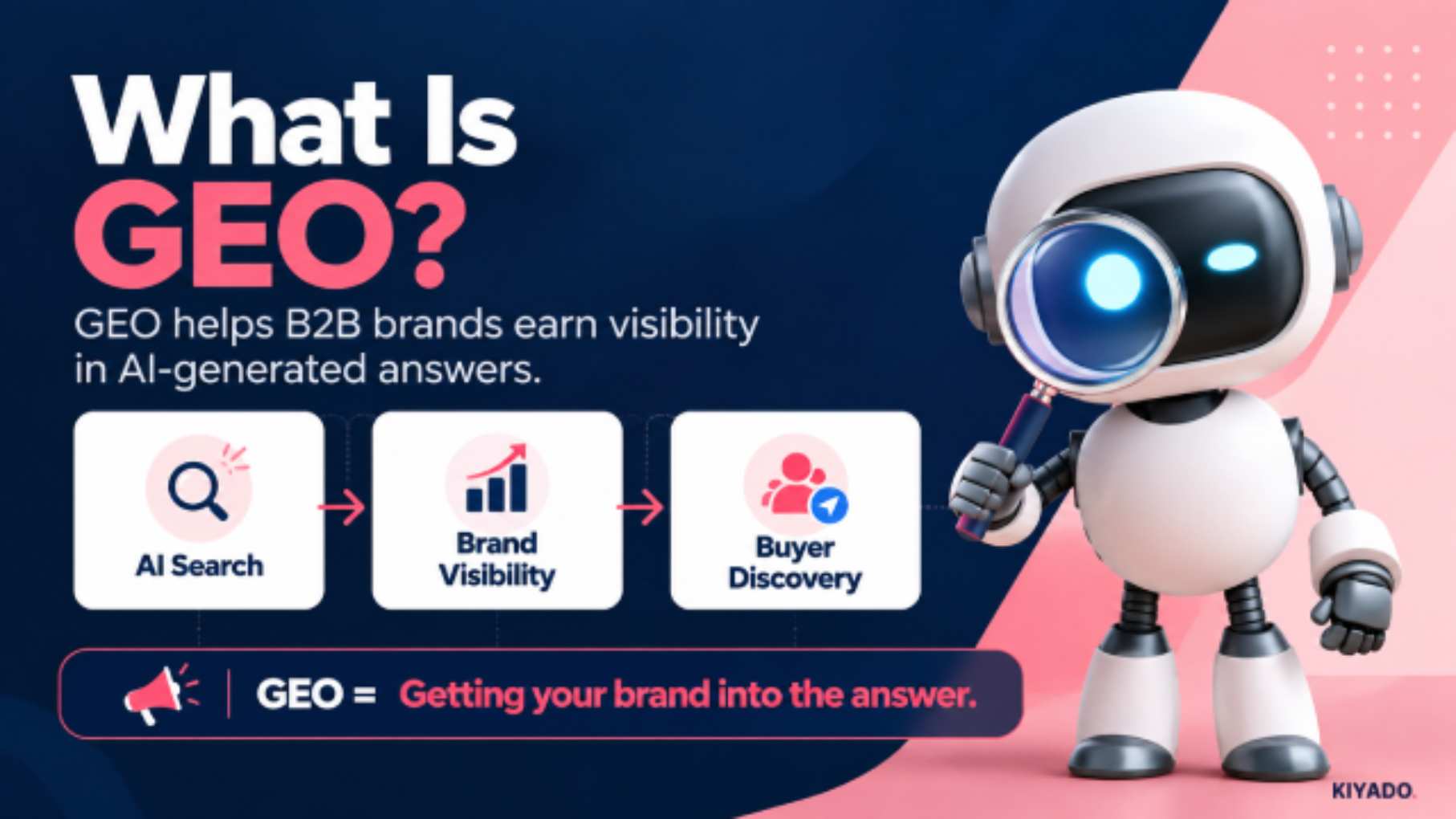
Search is changing from a list of links into a more conversational experience. People still use Google to discover websites, products, services, and businesses, but they are also asking AI-powered platforms to research topics, compare options, summarize information, and recommend solutions. That shift has created a new area of search visibility: Generative Engine Optimization (GEO). GEO focuses on helping brands become easier for AI-powered search systems to understand, retrieve, reference, and potentially recommend. It does not replace SEO. Instead, it expands how businesses think about visibility in a search environment where users can receive an answer before they ever click a traditional search result.
Understanding Generative Engine Optimization (GEO)
GEO is a search optimization approach that helps AI-powered systems understand, retrieve, cite, and potentially recommend information about a brand. so AI-powered search systems can better understand, retrieve, cite, and potentially recommend its information in generated answers. Traditional SEO asks, “How can my page rank for this search query?” GEO asks a broader question: “How can my brand become a useful and trusted source when an AI system answers this question?” Generative search can combine information from multiple sources before producing an answer. Instead of simply presenting links, an AI-powered search experience can interpret a question, retrieve relevant information, synthesize it, and provide supporting sources.
Why Is Generative Engine Optimization Important in 2026?
The importance of GEO comes from a fundamental change in how people discover information. A traditional journey can look like Keyword → Search results → Website → Decision. A generati ve journey can look more like Question → AI research → Synthesized answer → Sources → Consideration → Decision. This does not mean traditional search has disappeared. Users now have more ways to research a topic. Google’s current guidance explains that AI Overviews and AI Mode can use techniques such as retrieval-augmented generation and query fan-out to retrieve relevant information before generating an answer.
| Traditional SEO | Generative Search |
|---|---|
| Rankings and clicks | Answers, mentions and citations |
| Keyword-focused | Intent and context-focused |
| Search results | Synthesized responses |
| Website visibility | Broader digital visibility |
| Traffic-focused | Visibility, consideration and conversions |
GEO vs SEO: What Is the Difference?
GEO and SEO are closely connected, but they focus on different outcomes. Businesses should not choose SEO or GEO. The stronger approach is SEO + GEO.
| SEO | GEO |
|---|---|
| Focuses on search visibility | Focuses on AI-powered visibility |
| Rankings and clicks are major outcomes | Mentions, citations and recommendations become additional outcomes |
| Targets keywords and search intent | Targets questions, intent, context and entities |
| Optimizes webpages | Can involve the wider digital presence |
| Builds organic search authority | Builds information, entity and source authority |
A technically strong website gives search systems access to your information. Useful content answers audience questions. Authority and evidence make that information more credible. A clear brand entity helps systems understand who you are and what you offer.
How Does Generative Search Work?
There is no single universal GEO algorithm used by every AI platform. ChatGPT, Google, Gemini, Perplexity, and other systems can use different models, retrieval methods, indexes, ranking systems, and answer-generation processes. A useful simplified process is: User Question → Query Understanding → Query Expansion → Retrieval → Source Evaluation → Answer Generation → Citations.
Query Understanding
The system first needs to understand what the user is actually asking. “What is GEO?” is different from “How can a healthcare company improve visibility in AI search?” This is why GEO starts with search intent, not keyword repetition.
Query Expansion and Fan-Out
Complex questions may require multiple related searches. Google describes query fan-out as a process where related queries can be generated to retrieve additional information relevant to the original question.
Retrieval
The system needs to find information that could help answer the question. Technical SEO remains important because valuable content needs to be discoverable, crawlable, indexable, and accessible.
Source Evaluation
Not every source is equally useful. Relevance, quality, evidence, clarity, freshness, and context can influence usefulness. Exact mechanisms differ by platform and query.
Answer Generation
The system combines relevant information into a response. Useful, specific, and credible content can have an opportunity to contribute to that response.
What Makes Content GEO-Friendly?
One of the biggest misconceptions about GEO is that content needs a special AI-writing formula. It does not. Strong GEO content should focus on usefulness before optimization.
Relevance
The content should directly answer the question instead of simply repeating a target keyword.
Evidence
Original research, credible statistics, expert commentary, case studies, examples, references, and first-hand experience can give content stronger informational value.
Clarity
Definitions, descriptive headings, comparison tables, examples, and concise answers make complex information easier to understand.
Entity Clarity
AI systems need to understand who your organization is, what it does, which services it provides, which industries it serves, and what expertise it has.
Technical Accessibility
Crawlability, indexability, internal linking, site architecture, mobile usability, and accessible content remain important foundations.
How to Do Generative Engine Optimization
A practical GEO strategy begins with the questions that matter to your customers. Instead of researching only keywords, look at the complete information journey. For example, a company selling an AI healthcare solution might research questions such as “How can hospitals automate patient scheduling?”, “What should I look for in a healthcare AI platform?”, “How does AI improve patient engagement?”, and “Which healthcare AI solutions are worth considering?” These questions can become content opportunities. A strong pillar page can explain the main topic, cluster pages can answer narrower questions, service pages can target commercial intent, industry pages can demonstrate expertise, and research or case studies can provide original evidence. Internal linking connects these assets so users and search systems can understand the relationship between them. The goal is not to create hundreds of AI-generated pages, but fewer, stronger resources that provide information people actually need.
GEO Best Practices for 2026
Create unique information
Original research, expert insights, first-hand experience, proprietary data, and real examples give content something distinctive.
Answer questions directly
Give the core answer early, then provide context and depth.
Build topical depth
Use pillar and cluster content to cover related questions and subtopics.
Strengthen your brand entity
Keep company name, services, expertise, locations, authors, and business information accurate and consistent.
Support important claims
Provide evidence or reference a credible source when a statement matters.
Maintain strong technical SEO
AI search still depends on information that can be discovered and accessed.
Measure continuously
AI answers, competitors, and search systems change, so GEO should be ongoing.
GEO and the 2026 AI Search Trends
Search Is Becoming an Answer Layer
AI can help users understand complicated questions without requiring multiple page visits. Being a useful source within the research journey matters more.
Original Content Has More Strategic Value
Generic explanations are easy to reproduce. Original research, case studies, expert perspectives, and proprietary information can create stronger differentiation.
Search Is Becoming More Multi-Surface
A brand’s digital presence can involve websites, videos, social platforms, communities, reviews, business profiles, and publications.
GEO vs AEO vs LLMO
| Term | Main Focus |
|---|---|
| SEO | Search engine visibility |
| AEO | Answer visibility |
| GEO | Generative AI visibility |
| LLMO | Visibility and understanding within large language model ecosystems |
The terminology is still evolving. The practical objective matters more than the acronym: make your brand easy to discover, understand, verify, and trust across modern search experiences
How Do You Measure GEO?
Traditional SEO metrics remain important, but GEO introduces additional questions. Are you being mentioned for important prompts? Is your website cited? Which competitors appear instead? Is the AI describing your business accurately? Does AI discovery contribute to branded searches, visits, enquiries, or conversions?
| GEO Metric | What It Measures |
|---|---|
| Brand Mention Rate | How often your brand appears in target answers |
| Citation Rate | How often your content is used as a source |
| Competitor Visibility | Which competitors appear instead |
| Brand Accuracy | Whether your company is represented correctly |
| Citation Quality | Whether authoritative sources support visibility |
| AI-Referred Traffic | Visits influenced by AI discovery |
| Conversions | Business outcomes influenced by AI visibility |
Create a fixed list of important prompts and test them consistently. This provides a baseline, helps identify weak areas, and makes it possible to compare visibility over time.
Common GEO Mistakes
Treating GEO as Keyword Stuffing
Repeating “generative engine optimization” does not make content authoritative. Search intent, usefulness, evidence, and clarity matter more.
Publishing Generic AI Content
AI can assist productivity, but unedited generic content at scale lacks the originality and expertise needed for strong content.
Ignoring SEO
GEO is not a shortcut around technical SEO. A strong strategy still needs an accessible website and useful, indexable content.
Chasing Artificial Mentions
Irrelevant mentions do not automatically create authority. Build legitimate visibility where your industry and customers participate.
Measuring Only Traffic
AI can influence customers before they visit. Track mentions, citations, consideration, assisted traffic, and conversions too.
Does GEO Require Special Schema or llms.txt?
No special GEO schema is required for Google’s AI search features. Google’s current guidance says website owners should continue using established SEO best practices rather than relying on special AI markup. Similarly, llms.txt should not be treated as a required optimization for Google’s generative AI search features. The focus remains on accessible, useful, reliable content and strong SEO foundations. Structured data can still help describe supported entities and content when implemented correctly, but it should accurately represent the visible page rather than being used as a manipulation tactic.
The Future of Search: From Rankings to Recommendations
The future of search is not simply about replacing Google with AI. It is about search becoming more intelligent, conversational, and multi-layered.
People may discover a brand through a traditional result, ask an AI system to compare it with competitors, read reviews, watch a video, explore a community discussion, and finally return to the website to convert.
A successful brand therefore needs to be findable, understandable, credible, and useful across that journey. GEO is best understood as an extension of modern search strategy combining technical SEO, content quality, topical authority, entity clarity, evidence, reputation, and measurement.
Frequently Asked Questions About GEO
What is Generative Engine Optimization in simple terms?
GEO is the process of improving a brand’s digital presence so AI-powered search systems can understand its information and potentially use, cite, mention, or recommend it in generated answers.
Is GEO replacing SEO?
No. GEO complements SEO. Strong technical SEO, useful content, accessibility, and authority remain important foundations.
What is the difference between GEO and SEO?
SEO focuses primarily on traditional search visibility, while GEO focuses on how a brand and its information can appear within AI-generated answers and recommendations.
How do I optimize for AI search?
Start with technical SEO, then create useful original content, answer customer questions, strengthen topical authority, provide credible evidence, improve entity clarity, and measure relevant AI experiences.
The Future of Search: From Rankings to Recommendations
The future of search is not simply about replacing Google with AI. It is about search becoming more intelligent, conversational, and multi-layered.
People may discover a brand through a traditional result, ask an AI system to compare it with competitors, read reviews, watch a video, explore a community discussion, and finally return to the website to convert.
A successful brand therefore needs to be findable, understandable, credible, and useful across that journey. GEO is best understood as an extension of modern search strategy combining technical SEO, content quality, topical authority, entity clarity, evidence, reputation, and measurement.
Kiyado’s Approach to GEO
At Kiyado, GEO is not about abandoning SEO. It is about preparing brands for where search is going.
The strategy connects SEO, GEO, and AEO so businesses can build visibility across traditional search and emerging AI-powered experiences. The objective is to create content people find useful, build authority search systems can understand, and establish a digital presence that supports trust across the web.
As AI continues to influence how people research and make decisions, the question for businesses is no longer only, “How do we rank?” It is also, “When someone asks AI about our industry, are we part of the answer?”
That is the opportunity behind Generative Engine Optimization.
Quick GEO Takeaway
SEO helps people find your website. GEO helps AI systems understand and potentially surface your information. Authority gives both users and systems a reason to trust it. The brands that bring these three together will be better prepared for the next phase of search.
Rizwan Mohammed
Rizwan leads search and AI-visibility strategy at Kiyado, with 15+ years in SEO and a hands-on focus on turning analytics into a working roadmap rather than a monthly report nobody reads.